Walk into most UK kitchens and almond flour gets filed under one heading: baking. It goes into cakes, macarons, gluten-free bread. That’s a fair use of it – but it’s also a narrow one. In an Indian kitchen, almond flour has never been a baking-aisle specialty. It’s the backbone of some of the richest, most celebrated sweets in the repertoire: halwa that melts before it’s fully chewed, barfi with that particular dense-yet-soft bite, ladoo that holds together without a single egg or gram of flour-flour anywhere near it.
If you’ve only ever bought almond flour uk bakers use for sponge and shortbread, it’s worth knowing what it does in a saucepan of ghee and sugar, because the results are genuinely different from anything Western baking asks of it.
What Almond Flour Actually Is (And Why the Indian Kitchen Treats It Differently)
Almond flour is just almonds, finely ground – no bran, no wheat, no additives. In Western baking it behaves as a flour substitute: it needs binding agents, it doesn’t rise the way wheat flour does, and recipes are built around compensating for that.
Indian cooking doesn’t ask almond flour to behave like flour at all. It’s used as a base ingredient in its own right – cooked slowly with ghee, sugar, and milk or cream until it transforms texturally, rather than baked into a batter and left alone. That’s the fundamental difference, and it’s why almond flour earns a permanent place in an Indian pantry rather than a specialty-baking cupboard.
The quality of the almonds you start with matters more here than in most baking applications, because there’s nowhere for a stale or bitter batch to hide. Cooked slowly in ghee, off flavours concentrate rather than disappear. This is where premium almonds uk shoppers reach for pay off – freshness and oil content directly affect how smoothly the flour cooks down and how rich the final texture turns out.
Halwa: Where Almond Flour Does Its Best Work
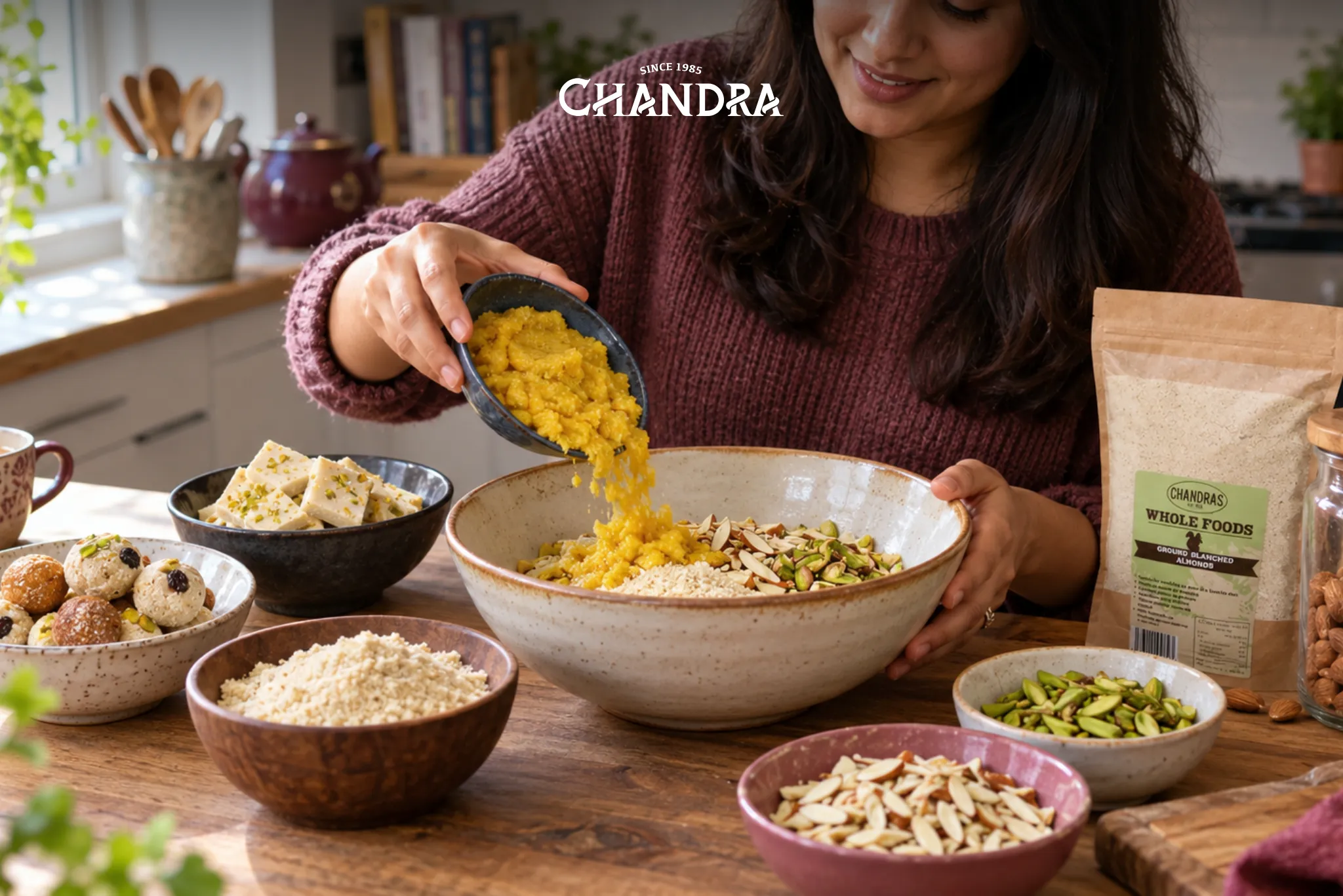
Badam halwa (almond halwa) is arguably the dish that shows off almond flour’s potential better than anything else in the Indian sweets canon. The method is simple in description and genuinely technical in execution: almond flour is cooked low and slow in ghee, with sugar and milk added gradually, until the mixture pulls away from the pan and turns glossy.
Done right, badam halwa has a texture unlike anything Western almond baking produces – dense, fudge-like, faintly grainy in the best possible way, with a shine that comes purely from the ghee re-emerging as the mixture thickens. It’s often served warm, sometimes with a few threads of saffron or a scatter of chopped pistachio, and it’s a fixture at weddings, festivals, and, properly, at Diwali.
The common mistake home cooks make is impatience – turning the heat up to speed things along. Almond flour scorches quickly once the ghee separates out, and a rushed halwa tastes bitter at the edges even when the centre is fine. Low heat and constant stirring for the full 20–25 minutes isn’t optional; it’s the entire technique.
Barfi: The Melt-in-the-Mouth Classic
Badam barfi takes the same base ingredients as halwa and pushes them toward a firmer, sliceable set. Where halwa stays soft and spoonable, barfi is cooked further – enough that it can be poured into a tray, cooled, and cut into diamonds or squares that hold their shape.
The texture Indian home cooks and sweet-shops chase is a specific kind of short, dense bite that dissolves rather than chews. That texture depends almost entirely on how finely and evenly the almonds were ground before cooking – inconsistent grind size shows up as a grainy, uneven barfi rather than the smooth set it’s meant to have. This is one of the few Indian sweets where blanched almonds bulk uk buyers get real value from, since blanching removes the skin that would otherwise fleck the finished barfi with darker bits and toughen the bite.
Silver leaf (vark) is the traditional finish on top, though it’s entirely optional and purely decorative – the flavour and texture are already there without it.
Ladoo: Rolling Almond Flour Into Tradition
Ladoo is the most forgiving of the three, which is probably why it’s the one most home cooks attempt first. Almond flour is toasted lightly in ghee, mixed with sugar (often powdered rather than granulated, for a smoother finish), sometimes cardamom, and rolled into small balls while the mixture is still warm enough to hold together.
Unlike halwa and barfi, ladoo doesn’t need a precise final consistency to succeed – it’s a dish built on ratio and warmth rather than technique under pressure. That makes it a good entry point if halwa’s constant-stirring demands feel intimidating.
What ladoo does demand is decent almond flour to start with, since there’s no long cooking process to disguise a poor-quality batch. If you’re going to buy almonds uk shoppers typically choose whole and grind at home, a fresh, high-oil-content almond will bind into ladoo far more readily than an older batch that’s dried out in storage – dry almonds crumble instead of rolling.
Almond Flour vs Almond Slices vs Whole Almonds: Which to Buy for What
This is where a lot of home cooks get their almond purchases wrong for Indian sweets specifically, because the format you buy genuinely changes the outcome:
- Ready-ground almond flour is the fastest route into halwa, barfi and ladoo, and the most consistent for beginners, since the grind is already even.
- Whole almonds, ground fresh at home, give a noticeably richer flavour because the oils haven’t had time to oxidise post-grinding – worth it for barfi in particular, where texture is everything.
- Almond slices online uk buyers pick up aren’t for the base of any of these three sweets – they’re a garnish. A scatter of toasted almond slices on top of finished halwa or barfi adds crunch and visual contrast against the smooth base, but slices ground into flour behave inconsistently because they’re often blanched and pre-roasted differently to whole raw almonds.
If you’re planning to make these sweets regularly rather than as a one-off, buying whole and grinding in small batches gives noticeably better results than a large bag of pre-ground flour that sits in the cupboard losing oil content over weeks.
Buying Almonds in the UK: What Actually Matters for Indian Sweets
A few practical points that don’t always make it into recipe blogs:
Freshness over price, most of the time. Almonds that have sat too long lose the oil content that gives halwa its shine and barfi its short texture. If you’re weighing up whole almonds cheap uk listings, check turnover and storage claims before price – a slightly higher cost for fresher stock usually pays for itself in the finished dish.
Buy in the quantity you’ll actually use. Festival season – Diwali, weddings, any occasion involving a full batch of sweets for family – is when people search to buy almonds wholesale uk, and for good reason: making halwa or barfi in small quantities is barely more effort than making a lot, so buying ahead of the season and freezing what you don’t use immediately is common practice among people who make these sweets every year.
Blanched vs skin-on depends on the dish. Barfi wants blanched, for the smooth finish. Halwa is more forgiving either way, since the long cooking process softens the skin regardless. Ladoo sits in between – blanched gives a cleaner colour, skin-on gives slightly more texture.
Storing Almond Flour So It Doesn’t Let You Down
Ground almonds oxidise faster than whole ones because more surface area is exposed to air. Kept at room temperature in a sealed container, almond flour is good for a few weeks before the flavour starts to flatten. In the fridge, that extends to a couple of months; in the freezer, considerably longer, with no real impact on how it performs in halwa, barfi or ladoo once brought back to room temperature.
If you’ve bought in bulk for a festival batch, freezing the surplus in smaller, labelled portions is worth the five minutes it takes – it means the almond flour you pull out for a ladoo batch in three months’ time still tastes like it should.
A Few Common Questions
- Can I substitute ready-made almond flour for freshly ground almonds in these recipes?
Yes, and for halwa and ladoo the difference is minor. For barfi, freshly ground almonds tend to give a slightly better set because the grind is more even and the oil hasn’t started to oxidise. - Why did my badam halwa turn out grainy instead of smooth?
Usually one of two things: the heat was too high and the sugar crystallised before the almonds fully absorbed the milk, or the almond flour itself was ground unevenly. Lower heat and a finer, more consistent grind both help. - Is almond flour the same as ground almonds for Indian cooking?
Functionally, yes – the terms are often used interchangeably in Indian recipes, unlike in Western baking where “almond flour” (blanched, fine) and “ground almonds” (skin-on, coarser) are sometimes distinguished more strictly. - How much almond flour do I need for a standard batch of barfi?
Most home recipes work from roughly a 1:1 ratio of almond flour to sugar by weight, adjusted to taste – sweeter for special occasions, slightly less for everyday batches.