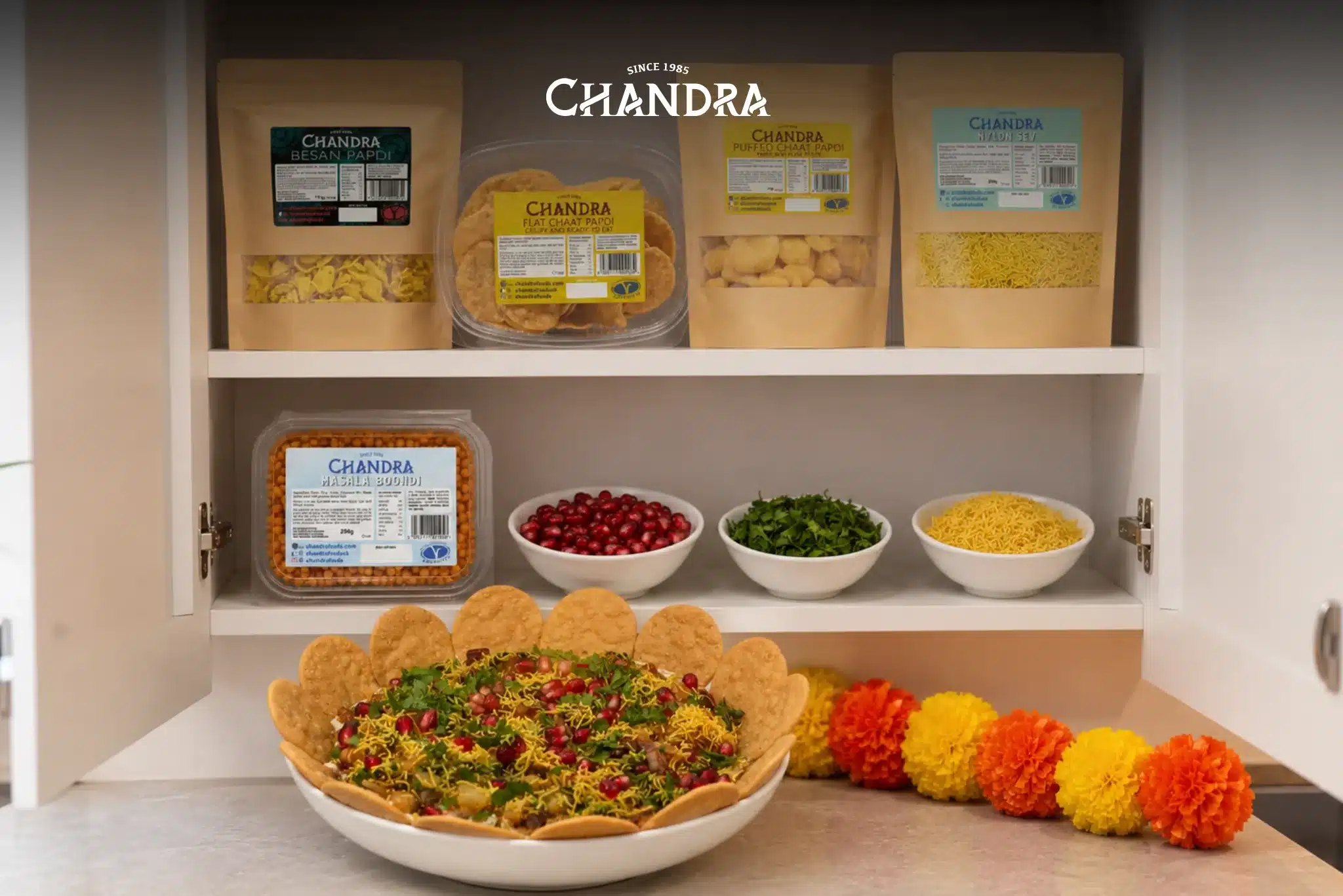
There is a particular kind of satisfaction in opening a cupboard and finding everything you need to make a proper chaat, without a last-minute dash to the shops. A packet of sev, a box of papdi, some puri shells, a jar of chutney, and suddenly you can put together something that tastes like it came off a street stall, in under fifteen minutes.
This is the idea behind a chaat station: a small, dedicated section of your kitchen cupboard stocked with the right dry and shelf-stable ingredients, so that making chaat becomes something you can do on a whim rather than something that needs a shopping trip and a plan. It sounds like a small thing, but once it is set up properly, it changes how often you actually end up making these snacks at home.
Think of it a bit like keeping a well-stocked spice rack, except instead of individual spices, you are keeping the fried snacks, sev, and chutneys that turn a handful of pantry basics into something that actually tastes like a chaat stall. It takes a little planning to set up the first time, but once it is in place, it more or less looks after itself.
Why a Dedicated Chaat Station Makes Sense
Most Indian snacking, especially chaat, relies on combining a handful of dry, shelf-stable ingredients with a few fresh ones. The dry components, puri shells, papdi, sev, gathiya, spice mixes, all keep well for weeks if stored properly. The fresh side, things like potatoes, onion, coriander, yoghurt, and lemon, are things most UK kitchens already have on hand or can pick up easily.
The problem most people run into is not a lack of interest in making chaat, but a lack of the right dry ingredients when the craving hits. You might have onions and potatoes in the kitchen, but no puri shells, no sev, and no black salt, which makes putting together anything authentic difficult. A chaat station solves this by keeping the shelf-stable half permanently stocked, so you are only ever one supermarket trip away from a full craving fix, rather than needing to plan a whole shopping list around it.
What to Stock: The Core Categories
Think of your chaat station in four categories. You do not need everything at once, but building it out over a few weeks means you will eventually have enough variety to make several different dishes without repeating yourself.
1. The Base: Puri, Papdi, and Similar Shells
This is the foundation of most chaat dishes. Puri shells are used for pani puri, while papdi, the flat, crisp discs, form the base for papdi chaat, sev puri, and dahi puri. Both keep well in an airtight container and are worth having on hand at the same time, since a lot of chaat recipes can flex between the two depending on what you feel like eating that day.
If you are stocking up, it is worth looking at Chandra Foods’ chaat snacks and pani puri range, which covers the base ingredients you will keep reaching for.
2. The Crunch: Sev and Namkeen
Sev is one of those ingredients that quietly makes almost every chaat dish better. It is scattered over papdi chaat, mixed into bhel, and used as a topping for pani puri filling. Beyond that, plain sev or a spicier version works as a standalone snack on its own, so it is rarely wasted even if you are not making a full chaat spread that week.
Alongside sev, other traditional namkeen like gathiya, chakri, and boondi are worth keeping around. These are not just chaat ingredients; they double as tea-time snacks, so stocking a few varieties gives you flexibility beyond just chaat nights. Chandra Foods stocks a wide range in their sev collection, covering everything from the classic thin sev to spicier, thicker varieties.
3. The Flavour: Chutneys and Spice Mixes
This is where the actual taste of chaat comes from. Tamarind chutney, green chutney, chaat masala, and black salt are the difference between a bland plate of fried snacks and something that actually tastes like chaat. These keep in the fridge or cupboard for a long time, so buying them once means you are set for several chaat nights before needing to restock.
If you are not confident making chutneys from scratch every time, ready-made versions work perfectly well and save a lot of prep time on the day, particularly if you are hosting people and do not want to be blending mint and coriander while guests are already at the table.
4. The Fresh Layer
The final piece is fresh produce, and this is the part that changes most often based on what you have available. Boiled potatoes, chickpeas, chopped onion, coriander, plain yoghurt, and a lemon are the usual suspects. None of these need special sourcing, and most UK kitchens already have several of them at any given time.
Keeping this in mind means that when the dry ingredients are stocked, you often only need to check the fridge for two or three fresh items rather than planning an entire shopping trip.
Organising the Cupboard Itself
Once you have decided what to stock, how you organise it matters more than people expect. A few practical points make a real difference:
Keep fried and crisp items in airtight containers. Puri shells, papdi, and sev all lose their crunch quickly once exposed to air, especially in a UK climate where kitchens can get humid. Transferring them from their original packaging into a sealed container as soon as you open them keeps them fresher for longer.
Group by dish rather than by ingredient type. Instead of separating “fried snacks” from “spice mixes,” it can help to group everything you would need for pani puri together, and everything for papdi chaat together, even if some items overlap. This makes assembly faster when you actually want to make something.
Store chutneys where you will see them. It is easy to forget about a jar of chutney at the back of the fridge. Keeping it near the front, alongside other condiments you use regularly, means it actually gets used rather than going untouched for weeks.
Rotate stock rather than letting things sit. Buy a little, use it, and restock, rather than buying in bulk and letting packets sit unopened for months. Chaat ingredients are best when reasonably fresh, and a smaller, regularly rotated stock beats a large one that goes stale before you get to it.
Quick Chaat You Can Make from a Stocked Cupboard
Once the station is set up, a few dishes come together in well under half an hour.
Papdi chaat, using papdi as a base, topped with mashed potato, chickpeas, yoghurt, both chutneys, and sev, is one of the fastest things you can put together, since nothing here needs cooking beyond boiling the potatoes ahead of time.
Bhel, a mix of puffed rice, sev, chopped onion, and chutney, is even quicker and needs almost no preparation beyond chopping a bit of onion and coriander.
Simple pani puri, if you keep a jug of pre-made pani in the fridge, can be assembled in minutes with just the puri shells and a basic potato filling.
None of these require anything you would not already have if the cupboard is stocked properly, which is really the whole point of setting one up in the first place.
Building the Station Without Overbuying
It is tempting to buy one of everything the first time you set this up, but that usually leads to half-used packets sitting around for months. A more sensible approach is to start with the essentials, puri shells, sev, and one type of chutney, use them a few times, and then expand based on what you actually reach for.
If you would rather set things up in one go without piecing it together item by item, the Family Pani Puri Combo covers the pani puri side, while the Papdi Chaat Combo handles the papdi chaat essentials. Between the two, you have a reasonably complete starting point for a chaat station without needing to guess at quantities or track down individual packets.
For a broader mix, particularly if you want variety in your namkeen selection rather than just one or two types, the Best of Chandra Combo brings together a wider range of traditional snacks, which works well if you are stocking up for the first time and want to see what you naturally gravitate towards before committing to specific items going forward.
Keeping It Going
The real value of a chaat station is not the first stock-up, it is keeping it going over time. Once you have used something, note it down or simply glance at what is running low the next time you are ordering. A small, well-maintained selection that gets used regularly is far more useful than a large one bought once and forgotten.
Checking in on the cupboard every few weeks, restocking what has run out, and swapping in something new occasionally keeps things interesting without turning it into a chore.
Frequently Asked Questions
- How long do puri shells and papdi actually last once opened?
- Once opened and transferred to an airtight container, they typically stay crisp for a couple of weeks, though this depends on humidity in your kitchen. If they do soften, a few minutes in a low oven usually brings the crunch back.
- Do I need to make chutney fresh every time?
- Not necessarily. Tamarind chutney in particular keeps well in the fridge for a couple of weeks, so making or buying a batch and using it across several chaat sessions is perfectly normal and saves a lot of time.
- What is the minimum I need to make a decent chaat at short notice?
- Papdi or puri shells, a packet of sev, some form of chutney, and a boiled potato are really the bare minimum. Everything else, onion, chickpeas, yoghurt, adds to the dish but is not strictly essential if you are keeping things simple.
- Can I keep this station vegan-friendly?
- Yes, easily. Most chaat components are naturally plant-based, and yoghurt is the main dairy ingredient that appears regularly. Swapping in a plant-based yoghurt, or simply leaving it out, keeps the rest of the dish unaffected.
- Is it worth buying spice mixes separately, or do they come with the snacks?
- Both are common. Some namkeen and chaat products come pre-seasoned, while things like chaat masala and black salt are usually bought separately as standalone spice jars, since they get used across multiple dishes rather than just one.
- What should I do with leftover chaat ingredients if I don’t finish everything?
- Sev and namkeen can simply be eaten on their own as a snack, so they rarely go to waste. Puri shells and papdi that have gone slightly soft are also fine reheated briefly in the oven before use next time.
- Is it expensive to set up a chaat station compared to just buying snacks as needed?
- Not really, since most of these ingredients are inexpensive to begin with and last for weeks once stocked. The main difference is buying a small batch of several items at once rather than one packet of crisps here and there, which tends to work out similarly in cost but gives you far more variety to choose from.
Shop the Products Mentioned in This Guide
You can order bhel puri mix, boondi and chakri from Chandra Foods, with free UK delivery on orders over £40.