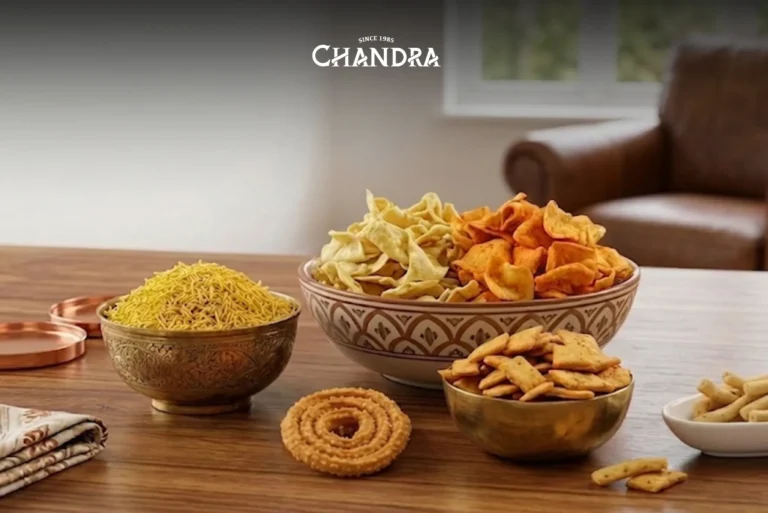

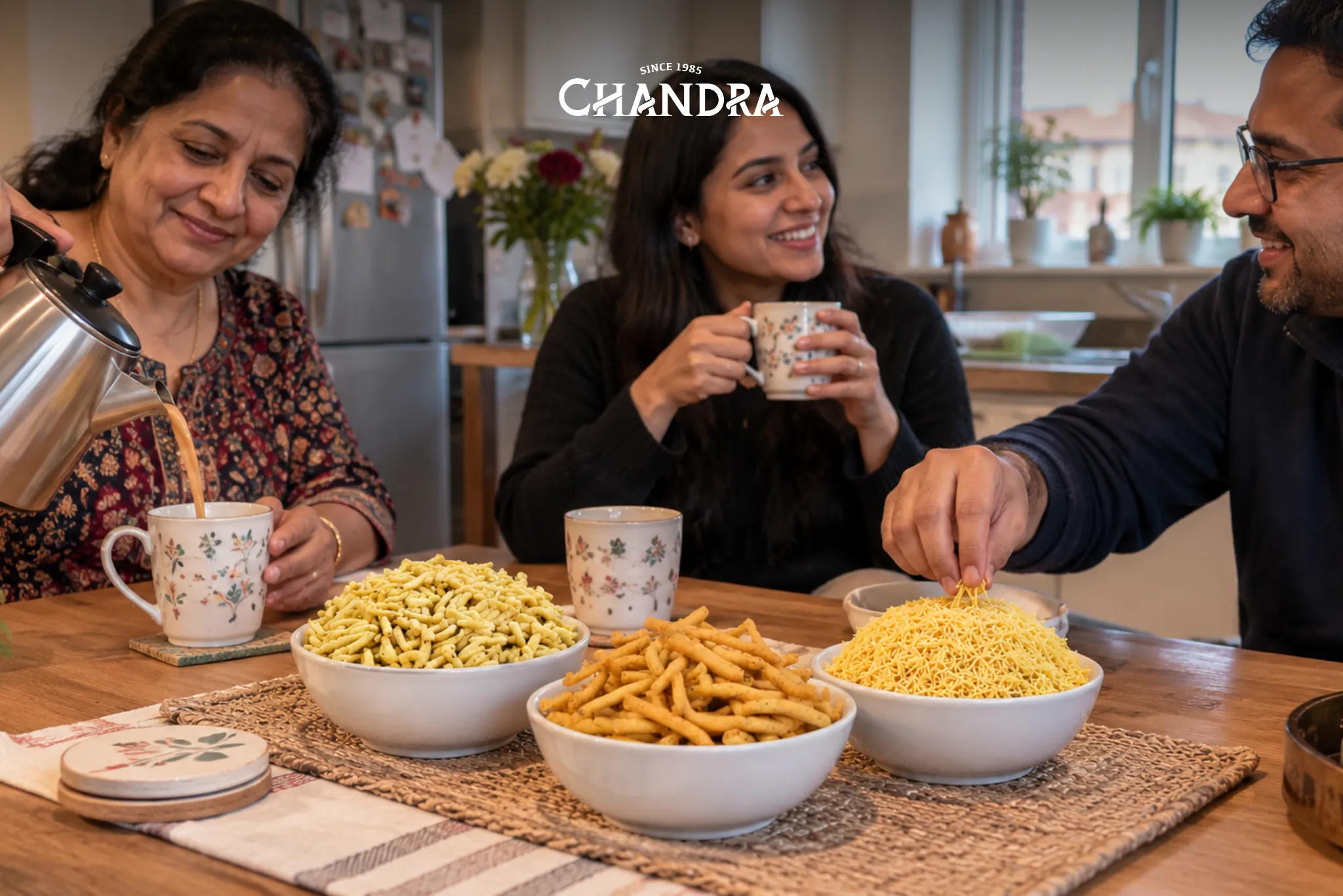
In a Gujarati home, chai is never served alone. The kettle goes on, and someone reaches for the tin, or the steel dabba, or the big glass jar on the top shelf. The best snacks for chai are dry, crunchy and salty-spicy, and they make a strong, sweet, milky cup taste even better. Three of them show up more often than any others: ganthiya, chevda and sev.
If you grew up with these, this post will feel familiar. If you didn’t, it’s a friendly guide to what they are, how they differ and how to serve them properly.
Why Gujarati Families Always Have Snacks for Chai Ready
Ask any Gujarati family what they keep in the cupboard and you’ll hear the same answer: something crunchy, something salty and something that lasts. Guests can turn up at four in the afternoon without warning. Nobody wants to cook, but nobody wants to serve tea with nothing on the side.
So the tin is always full. It’s a practical tradition as much as a cultural one. These snacks are fried in bulk, dry and shelf-stable, so a single batch can last for weeks. There’s a social side too. Handing someone a plate of namkeen with their tea is how you say “sit down, stay a while.”
Chai itself matters here. A typical Gujarati cup is strong and generous with milk, often sweet, and sometimes scented with ginger, cardamom or fresh mint. That richness is the reason the snacks are salty and sharp. The two are meant to balance each other. A plain biscuit would disappear next to that flavour, but a handful of spiced gram flour crunch holds its own.
Ganthiya: The Golden Classic
Let’s start with the one that has a hundred spellings. You’ll see ganthiya, gathiya, gathia and ganthia, all the same snack, and all the same to the person eating it.
Ganthiya is made from besan (gram flour). The dough is seasoned, most often with ajwain (carom seeds) and black pepper, then pressed into thick strands straight into hot oil. What comes out is a golden, chunky stick with a texture somewhere between soft and crisp, depending on the style. Some batches are almost melt-in-the-mouth. Others snap cleanly.
This is Gujarati namkeen at its most classic. Nearly every family has a version they swear by, and plenty of them have strong opinions about how thick it should be. The Bhavnagari style is the best known. It’s thicker and softer than the plain kind, and it has its own fan club (we’ll give it a full post of its own soon).
Traditionally, ganthiya isn’t eaten dry. The usual partners are:
- Papaya sambharo, a lightly spiced salad of raw grated papaya, a lovely fresh contrast to the fried snack
- Fried green chillies, salted and blistered, for anyone who likes some heat
- Green chutney and, of course, a hot cup of chai
Ganthiya is also the Sunday morning snack. Families often serve it alongside jalebi, and the sweet-and-savoury combination is a whole tradition in itself. If you’ve never tried it, one bite of ganthiya followed by a sip of sweet chai explains why it has lasted so long.
Chevda: The Sweet, Salty, Spicy Jar
If ganthiya is the classic, chevda is the crowd-pleaser. It’s a mix rather than a single snack, and no two families make it identically.
The base is thin poha (flattened rice), fried until it puffs up light and crisp. Then comes everything else: roasted peanuts, dried coconut slices, curry leaves, green chillies, sesame seeds, sometimes cashews or raisins. It’s finished with turmeric, salt and a pinch of sugar. That last ingredient is what makes the Gujarati style stand out. Good chevda is sweet, salty and spicy all at once, and it’s very hard to stop eating.
You may know a cousin of it by another name. In the UK, plenty of people meet this kind of snack as Bombay mix, though the shop-bought version is often heavier on lentils and gram flour pieces. Chevda is lighter and more poha-forward. If you’d like the full story of how one turned into the other, there’s a separate post on that coming this month.
For the tea table, chevda is the easy one to share. It sits in a bowl in the middle, everyone reaches in, and nobody needs a plate. It’s also the friendliest snack for anyone new to this world, because the flavours are balanced rather than fiery. If you’re stocking your cupboard with namkeen for the first time, chevda is usually the sensible place to start.
One useful note for fasting days: there’s a separate version made without the usual grains, known as farali chevda. It’s built on crunchy potato sticks with roasted nuts, seeds and raisins, so it suits vrat and upvas days. It’s also mild and light enough for any ordinary afternoon with tea.
Sev: The Crunch You Sprinkle On Everything
Sev is the simplest of the three, and probably the most versatile. It’s made from besan dough, pushed through a fine-holed press (a jhara) straight into hot oil, which makes long, thin, crisp strands. That’s really all it is: gram flour, a little oil, salt and spices.
What changes is the thickness and the seasoning. Some sev is so fine it’s almost like golden thread. Some is thicker and peppery. Ratlami sev, named after the town of Ratlam in Madhya Pradesh, is famous for its punchy mix of black pepper and clove. If you’d like to explore the whole range, there’s a full buyer’s guide to sev styles coming soon.
In a Gujarati kitchen, sev does a lot of jobs:
- Eaten by the handful with chai
- Scattered over poha or chaat for crunch
- Stirred into sev tameta nu shaak, the quick tomato curry that’s a weeknight staple
- Piled on top of a bowl of sev usal or dahi dishes
Because it’s so light, it’s the snack people tend to eat without noticing. That’s the danger and the charm. If you’d like to stock a few varieties at home, a decent selection of crispy sev will cover you for snacking, cooking and topping.
How to Build a Proper Chai Plate
You don’t need all three on the table every time, but here’s how families tend to put a plate together.
The everyday plate. A small bowl of chevda and a handful of ganthiya. Simple, quick, and enough for two cups of tea. Nobody has to plan it, and it takes about a minute to set out.
The guest plate. Add sev in a separate dish, some fried chillies and papaya sambharo, and maybe something sweet on the side. Put it all on a proper tray rather than straight from the packets. This is the one that makes visitors feel looked after.
The Sunday plate. Ganthiya and fafda with sambharo and chutney take the lead. If someone has gone out for jalebi, this is when it appears.
A few small habits make a real difference:
- Serve at room temperature. Never warm crunchy snacks in the microwave. Fresh out of the packet is best.
- Use a shallow bowl. It keeps the snack crisp and makes it easy for everyone to reach.
- Balance the flavours. If your chai is very sweet, lean on the spicier ganthiya. If it’s lightly spiced or less sweet, chevda’s sweetness works well.
- Keep a small bowl of something fresh. Sliced cucumber or a wedge of lemon cleans the palate between bites.
Choosing Tea Time Snacks in the UK
If you live in Britain, you already know that finding good tea time snacks UK shops stock isn’t as easy as it sounds. Supermarket shelves lean towards biscuits and crisps. Indian snack aisles, when they exist, are often stocked with generic mixes that don’t taste like home.
When you’re choosing the best tea time snacks UK sellers offer, here’s what to look for:
- A short ingredient list. Gram flour, oil, spices, salt. If you can’t recognise half the label, that’s a sign.
- Freshness. Fried snacks go stale quickly if they’re old or poorly packed. Check the date and the packaging.
- Regional character. A snack labelled Gujarati should taste Gujarati. Ganthiya with ajwain and pepper, chevda with a touch of sugar, sev with the right bite.
- Clear labelling. Look for allergen information and, if it matters to you, vegan-friendly notes.
Buying authentic Indian namkeen is really about paying attention to those details. The real thing tastes slightly different from the mass-market kind, and once you’ve noticed, it’s hard to go back.
Keeping Your Namkeen Fresh
A tin of namkeen is only as good as how you store it. Some simple rules:
- Use an airtight container. Steel tins, glass jars or good-quality plastic boxes all work.
- Keep it in a cool, dry cupboard. Away from the cooker, the kettle and anywhere steam collects. Moisture is the enemy of crunch.
- Don’t dip into the jar with wet hands. It sounds fussy, but one damp finger can soften a whole batch.
- Decant from big packs. If you buy in larger quantities, keep a small tin for everyday use and reseal the rest.
If a snack does go a little soft, you can crisp it back up in a low oven for a few minutes. This works best on sturdier snacks like chakri. Let it cool completely before you put it away.
Bringing It All Together
Ganthiya, chevda and sev are the heart of what Gujarati families offer with tea. Ganthiya brings the savoury, peppery crunch. Chevda brings the sweet, salty, spicy balance. Sev brings the lightness and the versatility. Together they cover almost every mood and every guest.
If you’re building your own collection of snacks for chai, start with one of each. Pour a strong cup, set out a small plate and see which one disappears first. In most houses, it’s a close race.
Frequently Asked Questions
- What are the best snacks for chai in a Gujarati home?
The most common choices are ganthiya, chevda and sev. Many families also keep fafda, chakri and papdi in the tin, and serve them with chai depending on the occasion. - Is ganthiya the same as gathiya?
Yes. The spelling varies (ganthiya, gathiya, gathia), but they all refer to the same besan-based fried snack. - What is the difference between chevda and Bombay mix?
Chevda is built on thin fried poha with peanuts, curry leaves and spices, and the Gujarati style has a hint of sweetness. Bombay mix is the British name for a similar snack mix, and it often contains more gram flour pieces and lentils. - How is sev different from ganthiya?
Both are made from gram flour, but sev is pressed into fine, thin strands, while ganthiya is thicker and softer. Sev is often used as a topping, while ganthiya is usually eaten on its own. - How long does namkeen stay fresh?
Stored in an airtight container in a cool, dry place, most fried namkeen stays crisp for several weeks. Always check the best-before date on the pack. - Can I eat these snacks if I’m vegan?
Traditional ganthiya, chevda and sev are usually made without dairy, but recipes vary between brands. Check the label, especially for sweet varieties.
Shop the Products Mentioned in This Guide
You can order ratlami sev and cashew nuts from Chandra Foods, with free UK delivery on orders over £40.